
Static site or server rendering? Cost and speed in practice
A marketing site that rebuilds every page on every visit is spending money and speed for nothing.
Founder & CTO, Parslinks
A design agency in Tehran built a marketing site for a dental clinic with Next.js and a CMS: home page, services, the dentists, articles and a booking form. Everything was server-rendered, because "content comes from the CMS and has to be fresh". The site works, but on mobile data the home page takes half a second to send its first byte, and every time the clinic runs an Instagram ad, the small server buckles.
The simple question nobody asked: how many times a day does this site's content change? The answer: a few times a month.
Two approaches, one site
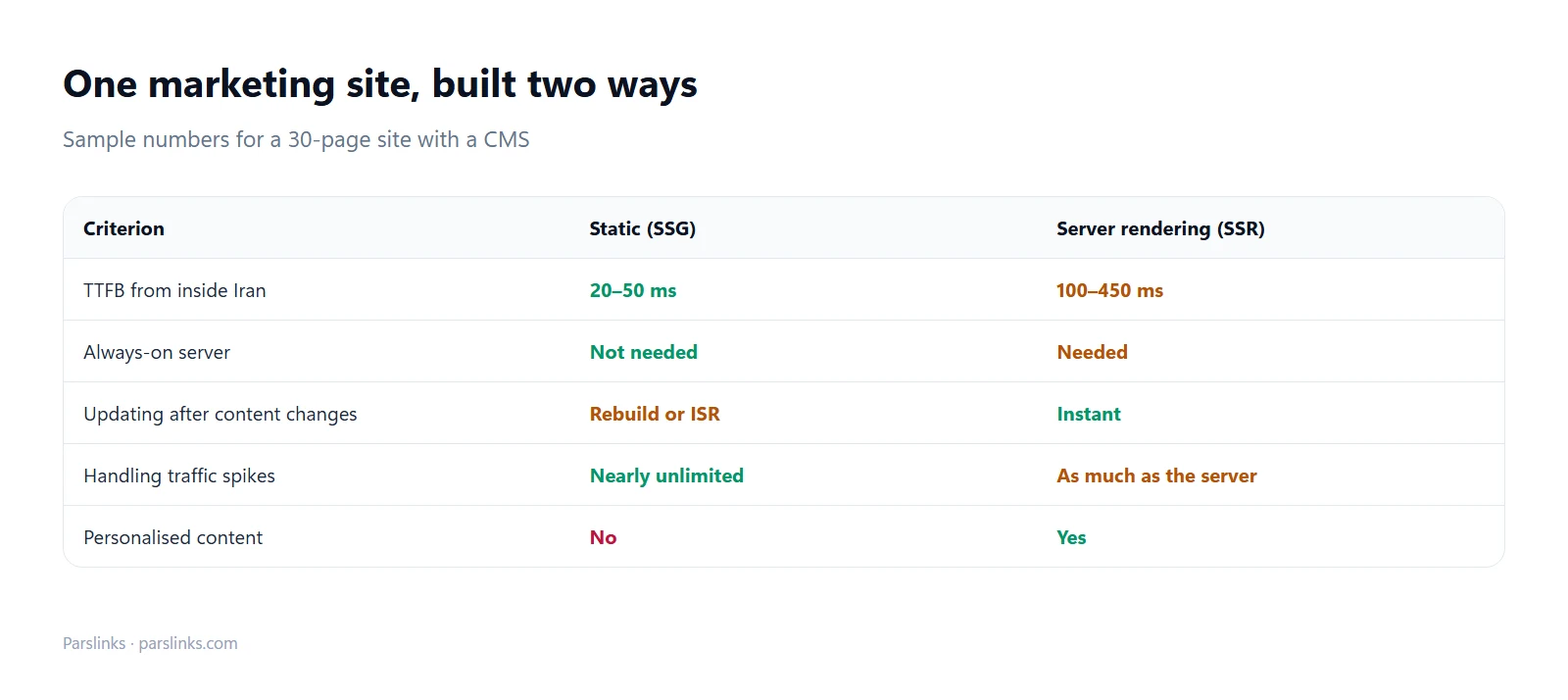
Static (SSG): each page is built once at build time and served as a ready HTML file. The server only hands out files, so it's fast, cheap, and traffic spikes barely register.
Server rendering (SSR): every request runs server code, fetches from the CMS and builds HTML. Always fresh, but response time depends on the CMS and server speed, and capacity is whatever the server can handle.
The numbers
The table's figures come from measuring that same site from Tehran on a fixed-line connection. On mobile data or at busy hours, the gap grows. More important than the exact numbers is the order: a ready file is always faster than building a page.
So when is SSR necessary?
When page content differs per user or must be exact at that moment:
- User dashboards, the cart, and anything behind login.
- Live stock and prices (though often only that part needs to be dynamic).
- Search results with endless filter combinations.
For the About page, the services list and blog articles, SSR is usually just cost.
The middle way: ISR
The agency's fair objection was: "If the clinic adds an article, we don't want to rebuild the whole site for every change." The answer is incremental static regeneration (ISR): pages are built and served statically, and when content changes, only that page is rebuilt in the background.
How it ended for the clinic
The agency made the public pages static with ISR and kept only the booking form dynamic. Home-page TTFB dropped from about 450 ms to under 50 ms, the small server stopped buckling under Instagram ads, and the clinic manager still publishes articles in the CMS and sees them live a few seconds later.
The simple rule: build each page with the least dynamism it actually needs.
Frequently asked questions
Join the discussion
No comments yet. Be the first to share your thoughts.
Related posts
- Deploy
Deploying Next.js to production: what SSG, ISR and SSR each need from your infrastructure
Each page's rendering mode decides what your server has to do. This post covers what SSG, ISR, SSR and PPR need from your infrastructure, how standalone output works, and what breaks once the app runs on more than one instance.
- Guides
Yalda night sales and Nowruz traffic: getting your site ready for the hour everyone shows up
The sale SMS goes out at 9pm, and in the first five minutes you get ten times a normal day's traffic. This post covers what breaks first under that load, how to load-test properly, and what to do from two weeks before until the morning after.
- Platform
A Vercel alternative for teams in Iran: what it actually has to replace
Foreign-card payments, the risk of a suspended account and unreliable access to vercel.app push teams in Iran to look elsewhere. But renting a server and running next start covers only a small part of what Vercel did. Here is the full list, and how the alternatives compare.